Nutraceutical Wholesale Australia: Import Rules for Brands
- Share
- publisher
- FORNUTRA Editorial Team
- Issue Time
- Nov 23,2026
Summary
Australia gates supplements behind TGA ARTG listing (AUST L) with 2026-27 fees, while Pakistan runs a 2026 licence-and-registration route under DRAP. This guide covers classification, documentation, TGO 116 labelling, duties, lead times and Incoterms for cross-border buyers.

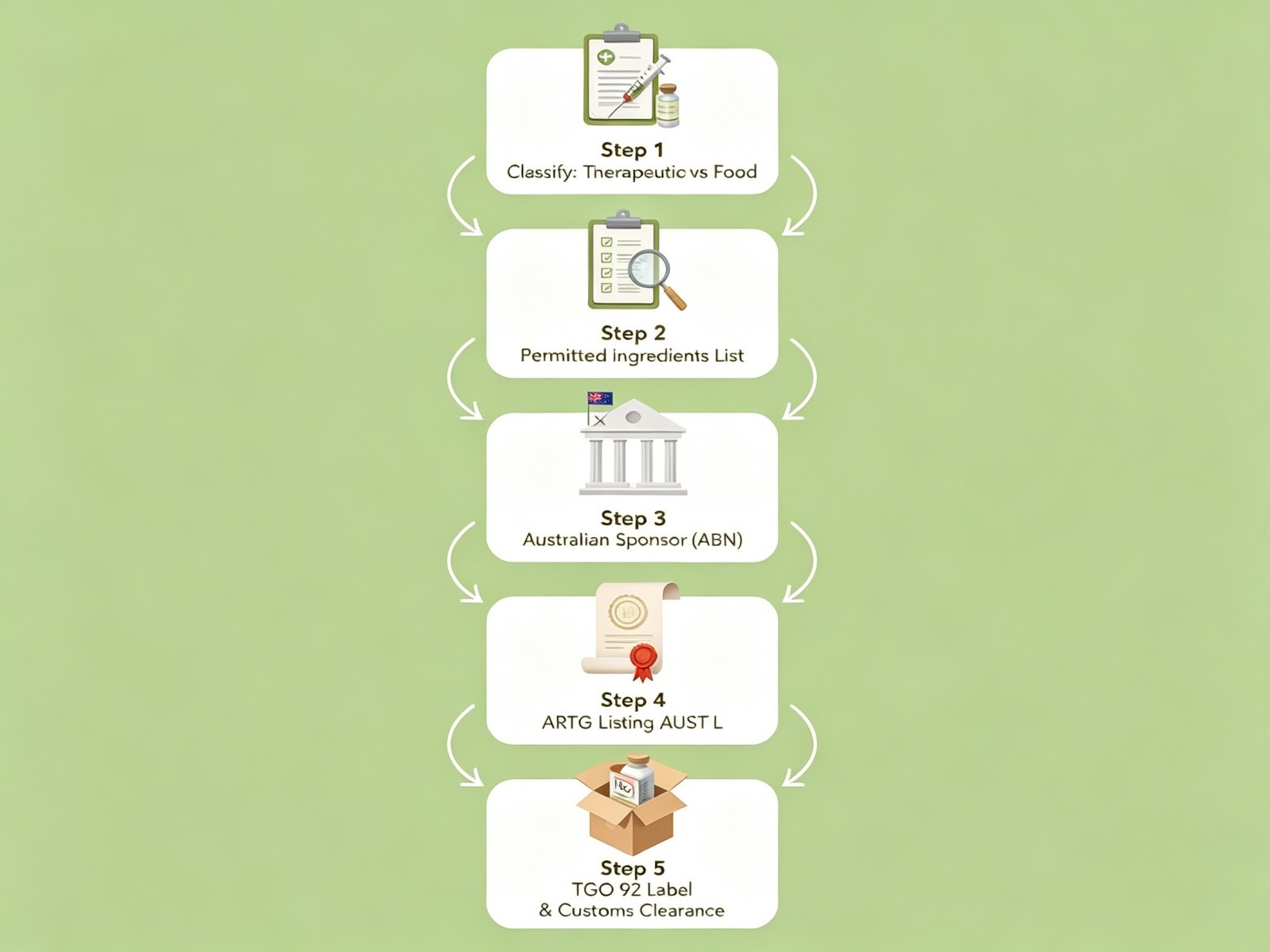
Importing supplements into Australia starts with one question — is the product a therapeutic good or an ordinary food? If it carries therapeutic claims, it needs an ARTG entry, usually an AUST L listing held by an Australian sponsor. Pakistan runs a separate 2026 licence-and-registration route under DRAP. Either way, the supplier must match documentation to the destination, not the factory.
Cross-border supplement sourcing usually hits the same wall: brands finish the formula, approve the artwork, and only then learn that the destination market will not clear the shipment. Australia will not accept a container of vitamins that has no Australian Register of Therapeutic Goods (ARTG) entry. Pakistan will hold goods that are not registered under its 2026 alternative medicines and health products rules. Before you compare freight quotes, compare the two rulebooks — and understand how the wholesale supply chain works in each market.
This guide keeps Australia as the main case — it is one of the most structured nutraceutical wholesale Australia import markets in the world — and uses Pakistan as a comparison to show how different a destination’s paperwork can be. It covers the documents that clear customs, the duties and labelling standards that apply, and the realistic lead times behind cross border supplement logistics.
Nutraceutical Wholesale Australia: Australia Supplement Import Rules
Australia is a large, gated market. According to the Complementary Medicines Australia (CMA) 2025 Industry Snapshot, the industry was worth approximately A$6.5 billion in 2025, including A$1.67 billion in exports, with 81% of Australians using vitamins or supplements at least occasionally. But “large market” does not mean “everything needs TGA approval” — the first step is classification.
Under the Therapeutic Goods Act 1989, the Therapeutic Goods Administration (TGA) regulates therapeutic goods — goods presented for therapeutic use, such as preventing, diagnosing or treating a condition. Ordinary foods, by contrast, sit under the Food Standards Australia New Zealand (FSANZ) Code. The deciding factor is how the product is presented: its claims, its form and its stated purpose.
- Likely TGA. A vitamin or herbal product sold with therapeutic indications — “supports immunity”, “relieves tiredness” — and in a medicinal dosage form is generally a listed (or assessed listed, or registered) medicine carrying an AUST L, AUST L(A) or AUST R number.
- Likely food. An ordinary food, or a product marketed purely as a food without therapeutic claims, may fall under FSANZ rather than the TGA — even if it contains vitamins or botanicals. Adding a therapeutic claim to the label pushes it into TGA territory.
Do not assume every vitamin, mineral or botanical product is a TGA medicine — and do not assume it is not. Classification drives the entire australia supplement import file, so confirm it before you lock the label. Misclassification is the most expensive mistake in this market: goods that should have been ARTG-listed can be stopped at the border, and post-market TGA audits can lead to cancelled listings and recalls.
The three TGA medicine pathways compared
| Pathway | AUST L (Listed) | AUST L(A) (Assessed Listed) | AUST R (Registered) |
|---|---|---|---|
| Pre-market review | None — sponsor self-certifies | TGA assesses the indications | Full TGA evaluation of safety, quality and efficacy |
| Ingredients | Permissible Ingredients list only | Permissible Ingredients list only | Flexible — new ingredients possible |
| Indications | Low-level permitted indications | Intermediate indications (may name a condition) | Custom indications with clinical evidence |
| 2026–27 application fee | A$1,063 | Higher — assessment applies | Higher — evaluation fees apply |
| 2026–27 annual charge | A$1,566 per entry | Set in the TGA fee schedule | Set in the TGA fee schedule |
| Label identifier | AUST L number | AUST L(A) number | AUST R number |
Sources: TGA Fees and Charges Summary from 1 July 2026 (Table 7); TGA guidance on listed, assessed listed and registered medicines. Application fees are one-off; annual charges recur per ARTG entry. Review timelines are not fixed commitments — they depend on dossier completeness and TGA workload.
For most wholesale buyers, AUST L is the default route: it is electronic and comparatively low-cost, but the sponsor carries full responsibility for every self-certified claim. If the factory cannot produce the quality dossier a sponsor needs — ingredient specifications, stability data, finished-product COAs — the listing stalls. That is why GMP, FDA and NSF certifications in supplement manufacturing matter as much to importers as to retailers.
Pakistan Supplement Import Requirements: A Contrast
Pakistan shows how different a destination’s paperwork can be. The relevant framework changed in 2026: the Alternative Medicines and Health Products Rules, 2026 (S.R.O. 2117(I)/2026, dated 16 November 2026) replaced the earlier 2014 enlistment rules, and DRAP launched its online licensing and registration system the same week. Rather than the old “enlistment” model, the 2026 rules run a licence + registration structure:
- Licence. An importer needs a licence to import finished products. Under the 2026 rules, the import licence application is made on the import-licence form (the licence to import finished product), while manufacturing licences use the manufacturing form — so do not carry forward the old 2014 form numbers into a 2026 application.
- Registration. Each product is registered separately. For imported health products, the application is the imported-generic or imported-new-product form, and the certificate of registration for an imported product is issued on its own form. Alternative medicines (unani, traditional Chinese medicine and similar) follow a parallel set of forms.
Foreign brands apply through a local authorized representative, and the import dossier must include documents duly attested, notarized and embassy-attested or apostilled in the country of origin: a Free Sale Certificate (a WHO-format Certificate of Pharmaceutical Product can stand in for the Free Sale, GMP and registration evidence), a GMP certificate for the principal manufacturer issued by the local regulatory authority, an agreement between the importer and the principal manufacturer, and a letter of authorization for export where the exporter is not the manufacturer. The product file itself must carry the master formula, manufacturing process, finished-product certificate of analysis (COA), and shelf-life supported by long-term and accelerated stability data.
Labelling is set out in Chapter 8 of the 2026 rules: labels must be in English and/or Urdu, and must list the product name, active ingredients with quantities, excipients, dosage form and directions for use. Note the change from older practice — the 2026 rules require English and/or Urdu, and the exact minimum label fields should be checked against the current schedule rather than assumed from past requirements. For Pakistan supplement import requirements, the lesson is the same as Australia’s: documentation is destination-specific, and a dossier that satisfies one regulator will not automatically satisfy the other.
TGA Listed Supplements, Documentation, Duties and Labelling
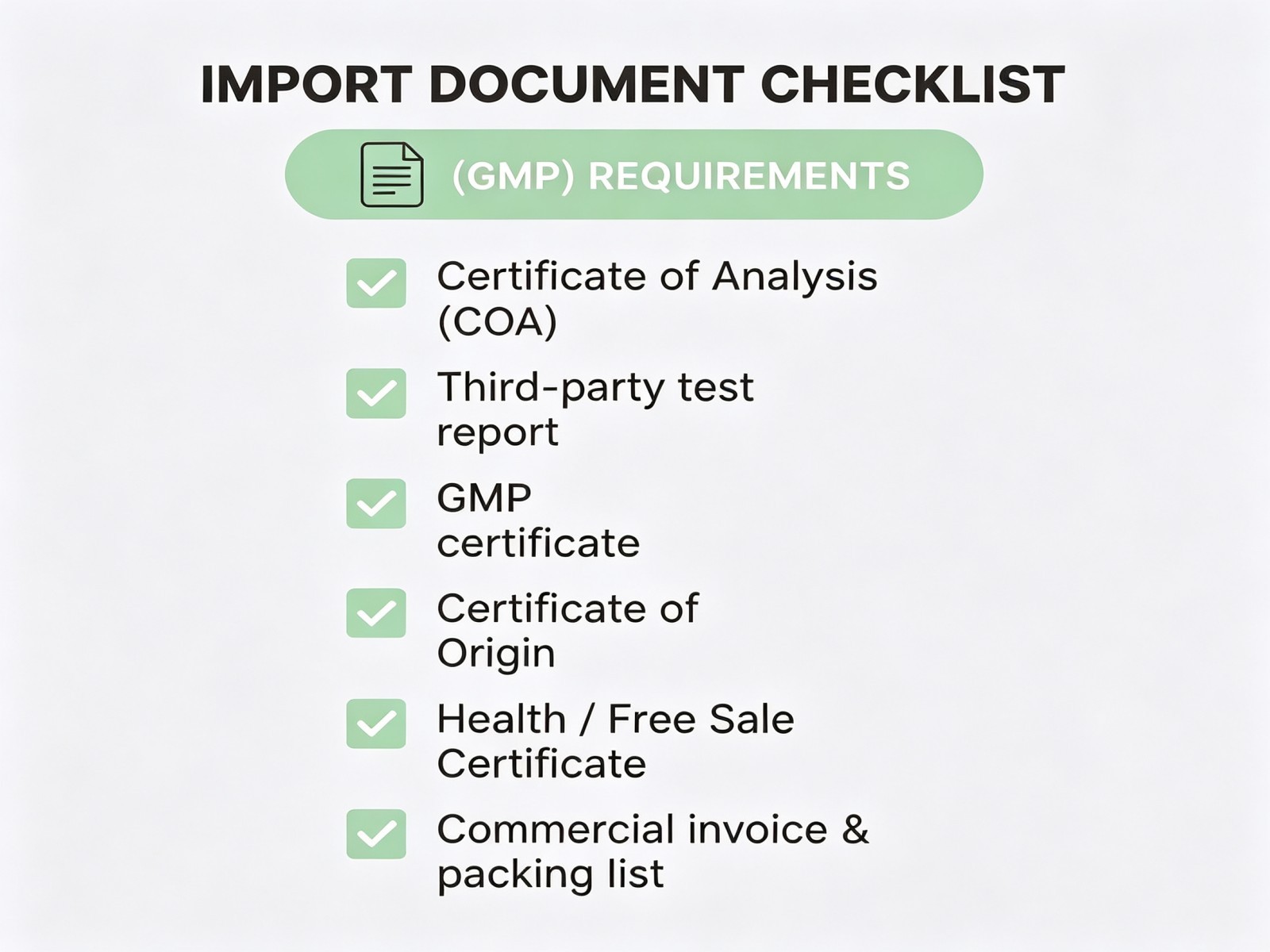
For tga listed supplements, the import file is built around one principle: every claim on the label must trace back to a permitted ingredient, a standard indication, and a manufacturer whose GMP evidence the TGA accepts. The practical file a buyer should expect from the factory:
- Certificate of Analysis (COA) for the finished batch, matching the product specification.
- Third-party test reports for identity, assay, heavy metals and microbiology.
- GMP certificate or equivalent GMP evidence covering the manufacturing site.
- Certificate of Origin for customs valuation and trade-agreement preference.
- Health / Free Sale Certificate for Pakistan (and several other markets), issued by the country of manufacture.
- Commercial invoice and packing list with correct HS codes and per-unit values.
On labelling, note that Australia’s rules changed in 2026. The TGO 116 standard (Therapeutic Goods (Standard for Labelling of Non-Prescription Medicines) Order 2026) took effect on 30 September 2026, replacing TGO 92, which sunset on 1 October 2026. There is a five-year transition period: non-prescription medicines may still comply with either TGO 92 or TGO 116, and all medicines released for supply after 1 October 2031 must comply with TGO 116.
On tax, 10% GST generally applies to imported goods, subject to the normal GST conditions and any concessions. Import duty is not a fixed percentage: it is determined by the HS code, the goods’ origin, and any applicable free-trade agreement (such as the China–Australia FTA for goods of qualifying origin). Confirm the effective rate with a licensed customs broker for your specific HS code before committing freight. Customs clearance is typically quick when documents are complete — often one to two working days — but that is a reference estimate, not a guarantee, and delays are almost always documentary or biosecurity-related. A deeper look at what a COA should contain is covered in our guide to the certificate and testing requirements from vitamin wholesalers.
Choosing a Supplier for Cross-Border Supply
The decision rule is simple: choose a supplier that can produce destination-market documentation, not just a competitive price. Three checks separate import-ready factories from the rest:
- Can they issue a full finished-product COA against your specification? Ask for a specimen COA before ordering, not after production.
- Do they hold quality certifications you can actually verify? FORNUTRA’s certificate page lists a GMP (food manufacturing) certificate, FDA food-facility registration, HACCP, ISO 22000 and ISO 9001 certifications. These are food-safety and quality-management credentials — they are not a substitute for, and do not automatically satisfy, a TGA GMP clearance or any other target-market approval. What they do provide is verifiable production-quality documentation that a buyer can submit as part of a target-market compliance assessment.
- Have they shipped to your destination before? Market-specific label files — TGO 116-compliant artwork for Australia, English/Urdu artwork for Pakistan — should already exist in their process, not be invented on your timeline.
Brands that want the factory to own the full process — formulation, batch records, testing and export documents — should look at contract manufacturing for dietary supplements under a single quality system, so the COA, GMP evidence and traceability records all reference one audited site.
| Document or requirement | Australia (TGA) | Pakistan (DRAP) | EU (baseline reference) |
|---|---|---|---|
| Pre-market entry | ARTG listing or registration | Import licence + product registration | Notification in each member state |
| Local entity | Australian sponsor (ABN) | Local authorized representative | EU responsible person |
| Manufacturing evidence | GMP evidence accepted by TGA | GMP certificate + Free Sale Certificate | HACCP / GMP per national rules |
| Label standard | TGO 116 (TGO 92 during transition) | English and/or Urdu | EU Regulation 1169/2011 food labelling |
| Import tax | 10% GST + duty by HS code and origin | Duty varies by HS code | VAT by member state |
The EU column is a baseline reference only — member states add national notification and language requirements. Duty rates change and depend on HS code, origin and trade agreements; confirm current rates with a licensed broker before shipping.
Lead Time and Incoterms for Long-Haul Shipping
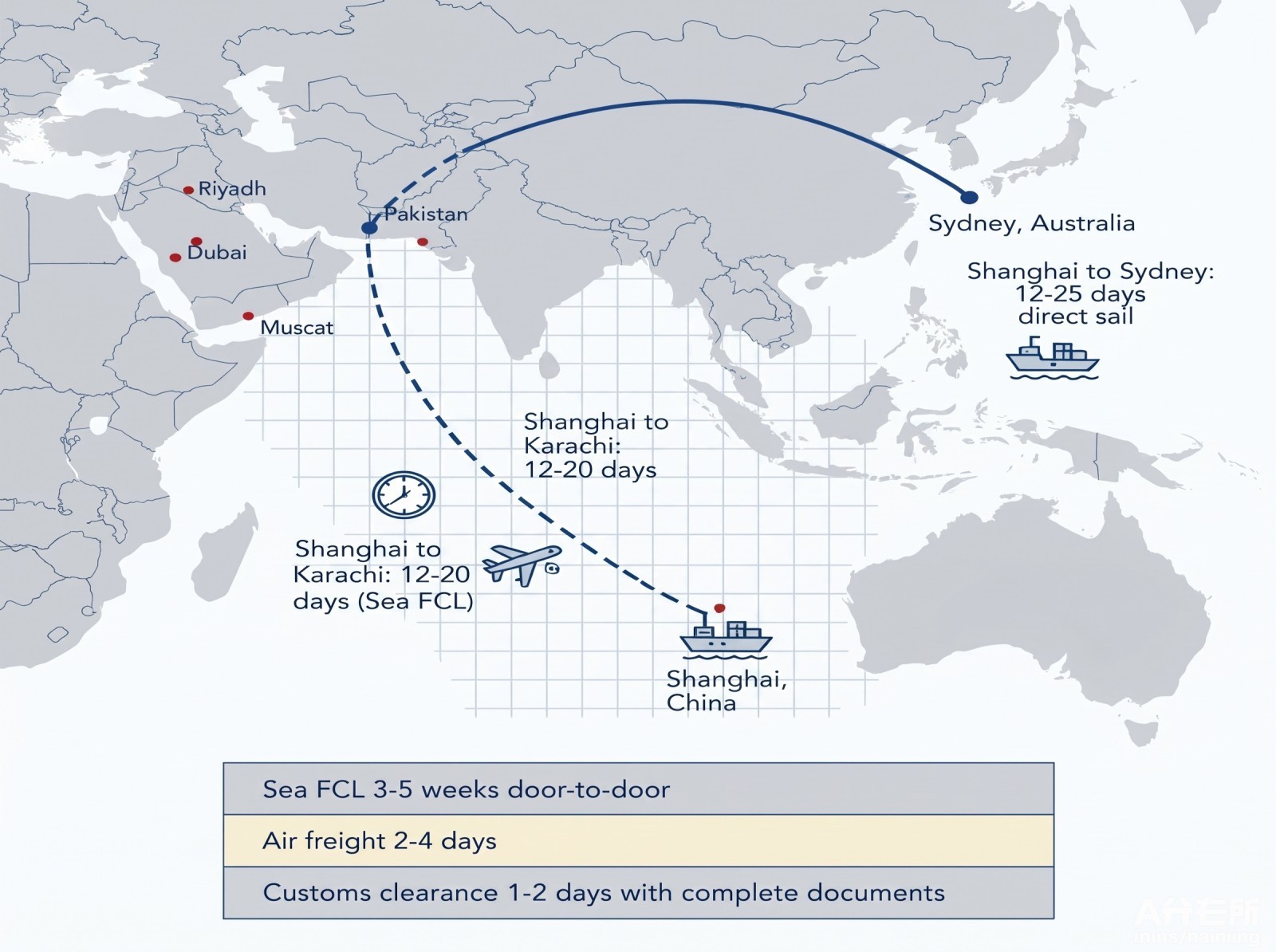
Plan the calendar backwards from the retail shelf. Getting cross border supplement logistics right is a scheduling discipline, not a guess: ocean freight from Chinese ports to Sydney typically runs around 12–25 days on direct sailings, and to Karachi around 12–20 days, with door-to-door totals of roughly 3–5 weeks once consolidation, customs and final delivery are added — these are reference estimates that vary by carrier, route and season, not fixed commitments. Air freight lands in 1–3 days but multiplies cost per kilogram, and is usually reserved for samples and urgent top-ups.
Incoterms decide who owns the compliance work. Under EXW you carry everything from the factory gate; FOB moves risk at the origin port; CIF adds freight and insurance to the destination port; DDP pushes clearance and duty onto the seller — attractive, but only with a partner who genuinely controls the destination paperwork. For light, high-value formats such as stick powders, freight per unit is lower than for liquids and glass, which is why many importers review the powder supplement manufacturer option before locking a dosage form — shipping economics should be part of the formulation decision, not an afterthought.
Plan Your First Import with FORNUTRA
FORNUTRA has supported more than 5,000 brands across 50+ countries over 17+ years, with three manufacturing facilities, a 30,000 ㎡ production campus, an 8,000 ㎡ GMP cleanroom and 20 production lines. Its export package is built for destination markets, not just the factory gate: finished-product COAs, third-party test reports, stability data and certification documents (GMP, FDA registration, HACCP, ISO 22000 and ISO 9001) that a buyer can submit for a target-market compliance assessment.
Typical starting points for cross-border buyers, as reference only — final terms depend on formulation, packaging and customization, and are confirmed in the official quotation: MOQs from 500 bottles per SKU for gummies, capsules, tablets and drops, 200 kg per SKU for powders, 30,000 vials for oral liquids and 200,000 softgels for softgel lines; sample lead time of about 1 week; mass production in 10–15 days once formula, packaging and materials are confirmed; and a production-and-delivery cycle of roughly 4–6 weeks for a ready-made formula (longer for a fully custom project). None of these figures is a fixed commitment — they are FORNUTRA’s published program references, and every quotation is confirmed in writing.
Whether your next container is bound for Sydney or Karachi, the fastest way to de-risk the shipment is a document review before production starts. Send us your target market and SKU list, and our compliance team will map the exact documentation, labelling and testing route for your first import.
Contact FORNUTRA for a market entry document listFAQ
Who is the importer of record?
In Australia, the sponsor — the Australian entity holding the ARTG entry — is the legal party responsible for the product, even though customs clearance is handled by a licensed broker. In Pakistan, the party holding the import licence and product registration under the 2026 rules is the importer of record. In both markets, the overseas factory is the supplier, not the importer — so destination-market licences and registrations are the buyer’s or local partner’s obligation.
Can the factory handle destination labelling?
Yes, if it has done it before. A qualified contract manufacturer prints TGO 116-compliant artwork for Australia (or TGO 92 during the transition period) and English/Urdu labels for Pakistan at the packing line, and issues the supporting COA, GMP and stability documents. But compliance responsibility stays with the sponsor or registered importer — the factory’s job is to produce the label and the evidence that supports it, exactly as approved.