Private Label Custom Supplement Manufacturers: OEM vs ODM Options for Your Brand in 2026
- Share
- publisher
- FORNUTRA
- Issue Time
- Sep 28,2026
Summary
A practical guide to private label, OEM and ODM supplement manufacturing: how they differ, who owns the formula, and how to brief a manufacturer to go from concept to scaled production.
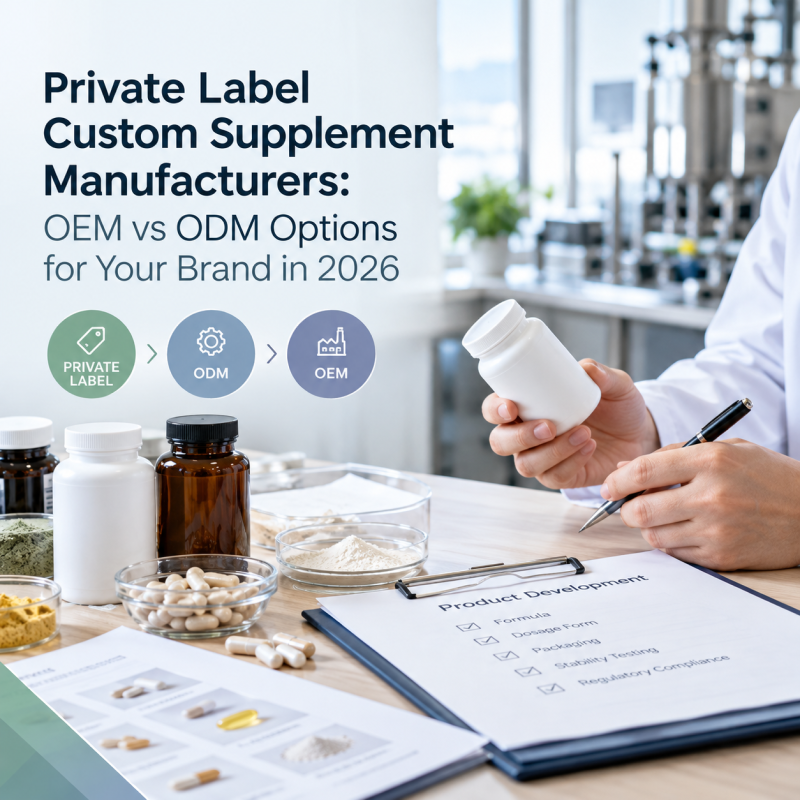
Private label means you apply your brand to a ready-made formula the manufacturer already produces. OEM (original equipment manufacturing) usually means the brand provides or leads the formula and specification, and the manufacturer produces to them. ODM (original design manufacturing) usually means the manufacturer develops or co-develops the formula from your brief. Formula ownership, usage rights, and exclusivity are set by the contract, not the model name. Every supplement brand reaches the same decision point: buy an existing product and put your name on it, or build something of your own. The route you choose — private label, OEM, or ODM — shapes who develops the formula, how much you invest, and how fast you can launch. This guide explains the three models, shows you how to brief a private label custom supplement manufacturer, and helps you decide when to move between routes. "Custom" is a sliding scale, not a yes-or-no switch. When a brand approaches a private label food supplements manufacturer, the customization it needs usually falls into one of three tiers — and knowing which prevents overpaying. A stock formula in a standard dosage form — capsules, tablets, softgels, gummies, or powder. You choose the product, then add your label, bottle, and packaging. It is a faster route to market with a lower minimum order and upfront cost, which makes it a common entry point for own label nutraceuticals. An existing formula adjusted to your brief — changing a dosage, swapping an ingredient, adding a flavor, or moving from capsule to gummy. Modified formulas give you differentiation without the full cost and timeline of new development, and they are a common first step toward private labeling supplement manufacturers. A formula developed from scratch around your target market, your dose, and your desired claims. Fully custom work means real supplement formulation — ingredient selection, stability testing, and specification setting — the domain of OEM and ODM. Once a brand moves beyond a stock formula, it has two development paths. OEM (original equipment manufacturing) usually means the brand provides or leads the formula and specification — the ingredient profile and target claims — and the manufacturer produces to them. ODM (original design manufacturing) usually means the manufacturer develops — or helps develop — the formula from your requirements. You provide the brief — market, dosage form, target claims, price point — and the factory's R&D team designs a formula it can produce. ODM delivers a tailored product with a lighter development burden, and formula ownership depends on the contract. The table summarizes the key differences for a buyer. For nutraceutical products — vitamins, minerals, botanicals, and functional ingredients — private labeling nutraceuticals and full custom development solve different problems. Demand is broad: the Council for Responsible Nutrition's 2024 survey found that 75% of U.S. adults use dietary supplements, and 69% of supplement users consider a personalized regimen important.[1] Private label wins on speed and cash flow: you can order a proven formula and have labeled stock ready to sell without development. The trade-off is that your product is largely interchangeable with competitors selling the same stock formula. Full custom development wins on defensibility. A proprietary blend, unique dosage form, or differentiated claim can command a higher price and be harder to copy. Cost and timeline are higher, and regulatory and quality responsibility falls on you as the brand owner. Under the U.S. Dietary Supplement Health and Education Act of 1994 (DSHEA), the FDA does not approve dietary supplements before they are marketed; the brand owner is responsible for safety, labeling, and substantiated claims.[2] A common misconception is that OEM formulas belong to the customer and ODM formulas belong to the manufacturer. Ownership, usage rights, and exclusivity are all defined by the contract, not by the model name. In OEM, the brand commonly provides or leads the formula, so it often retains ownership — but confirm in writing whether the manufacturer gains any production license. In ODM, the manufacturer commonly develops the formula, so it may hold ownership unless the contract transfers it, grants you market exclusivity, or restricts re-sale. Put ownership, usage, and exclusivity terms in the agreement before you pay for development. For more selection criteria, see our guide on how to choose a health supplement manufacturer. A good brief shortens development and reduces rework. These six elements cover what a private label custom supplement manufacturer needs to quote and develop accurately. After you submit a brief, a competent partner moves through a defined sequence before production. Once the sample is approved, the project shifts from development to manufacturing: pilot production, specification freeze, full-scale production, in-process and finished-product testing, then labeling and release. For U.S. supplement products, production must follow current good manufacturing practice (cGMP) under FDA 21 CFR Part 111, which requires written specifications for components, the manufacturing process, labeling and packaging, and finished products, and requires manufacturers to verify the identity, purity, strength, and composition of each finished batch.[4] The NIH Office of Dietary Supplements offers a plain-language overview of these obligations.[5] A reliable partner provides batch documentation, certificates of analysis, and a clear scale-up path — the same criteria we cover in our guide to finding a reliable supplement contract manufacturer. It may be time to move beyond private label when sales are repeatable, when differentiation is needed to defend margin, when a competitor sells the same stock formula, or when the target market requires a claim or dosage the stock product cannot support. The move can go from private label to ODM, or directly to OEM for a proprietary formula. If you’re weighing the options, review the trade-offs in custom supplement contract manufacturing. FORNUTRA supports all three routes. Start with private label supplement manufacturing to enter a market quickly, move into ODM for a tailored formula, and bring proprietary formulations through full OEM development backed by supplement formulation and R&D support. We also help you decide whether ready-made or custom development fits — covered in our guide to private label nutraceutical manufacturers. Yes. Bringing your own formula moves you from private label into OEM territory. A custom supplement contract manufacturing partner can produce it to your specification — confirm in the contract who owns and controls it. In OEM, the brand that provides or leads the formula often retains ownership, but ownership, usage rights, and exclusivity are set by the contract, not by the model name. Document these terms before development begins. OEM usually means the brand provides or leads the formula, and the factory produces to it. ODM usually means the factory develops — or helps develop — the formula from your brief. Ownership of the resulting formula depends on the contract. It follows a defined sequence: brief, feasibility review, quotation, lab sample, stability and testing, approval, and scaled production. A clear brief keeps the process on track. Whether you need a ready-made formula, a tailored ODM product, or a fully custom OEM formula, FORNUTRA can evaluate your project and recommend the most cost-effective route to market. Contact our team for a project assessment, or submit your specification to receive development guidance and a quotation.1. What "Custom" Really Means at a Private Label Supplement Manufacturing Partner
Ready-Made Formula
Modified Formula
Fully Custom Formula

2. OEM vs ODM: Two Routes to a Custom Formula
3. Private Label vs ODM vs OEM: A Side-by-Side Comparison
Aspect
Private Label
ODM
OEM
Formula Development
None — use a stock formula
Manufacturer develops from your brief
You provide or lead the formula and spec
Customization
Label and packaging only
Formula tailored to your market
Brand-led formula and specification
Development Input
Minimal — choose a SKU
Moderate — a clear brief
High — full spec and testing
Cost / Time Considerations
Lower cost, faster launch
Mid cost, weeks to months
Higher cost, longer timeline
Suitable For
Testing a market or niche
Differentiation without an R&D team
Proprietary, patented blends
4. Private Labeling Nutraceuticals vs Full Custom Development
5. Who Owns the Formula in a Custom Supplement Project?
6. How to Brief a Private Label Custom Supplement Manufacturer
Element
What to Specify
Target Market
Country or region, consumer profile, and retail channel
Dosage Form
Capsule, tablet, softgel, gummy, powder, or liquid
Formula
Active ingredients, dosage per serving, and any exclusions
Packaging
Bottle, pouch, or blister, plus count and label requirements
Claims
Desired structure-function claims and any marketing angle
Regulatory Requirements
Target-market standards such as FDA 21 CFR Part 111, EU, or Health Canada
7. From Formula Brief to Approved Sample
8. From Approved Formula to Scaled Production
9. When Should a Brand Move From Private Label to OEM or ODM?
10. How FORNUTRA Supports Private Label, ODM and Custom OEM Projects
FAQ
Can I use my own formula with a private label manufacturer?
Who owns the formula in OEM supplements?
What is the difference between OEM and ODM supplements?
How does custom supplement development work?
References
Start Your Private Label, OEM or ODM Project