Private Label Supplement Manufacturer Reviews: How to Evaluate Ratings and Verify Claims
- Share
- publisher
- FORNUTRA
- Issue Time
- Oct 26,2026
Summary
Learn how to judge whether private label supplement manufacturer reviews are trustworthy, spot rating bias, and verify claims through reference calls, quality documents, and sample checks.
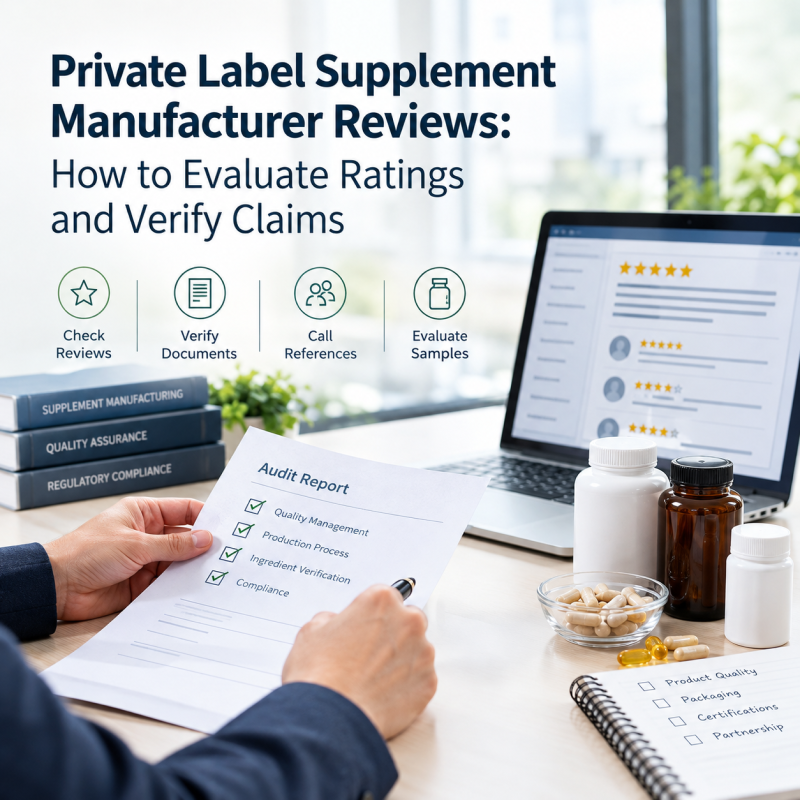
Star ratings are easy to find and just as easy to misread. A five-star average may reflect a handful of small orders, a coordinated push, or genuine quality — the rating alone cannot tell you which. For a brand evaluating a private label supplement manufacturer, an online review is a pointer to something you still need to verify, not proof of how a facility will perform on your product type, batch size, and documentation requirements. Direct answer Manufacturer reviews are a starting signal, not proof. Cross-check any rating against audit documents, reference calls, and sample evaluations before deciding. A five-star rating with no verifiable detail tells you little; a specific, documented complaint shows you where to probe. Treat every review as a lead to confirm, never as a conclusion. Table of Contents A quality professional reviewing documentation in a supplement manufacturing facility — the documents behind a rating matter more than the stars. Each source has a different value — and a different blind spot. Here is how the three main ones compare. No single source is sufficient on its own. Cross-reference at least two before treating a manufacturer as a serious candidate — and treat every source as a lead, not a verdict. Patterns worth checking before you trust a rating: Negative reviews are often the most useful, because they point to failure modes you can test for: None of these patterns proves misconduct. A pattern is a reason to investigate, not evidence of wrongdoing — only a document or a reference that confirms it should move your decision. A reference call turns an anonymous review into a checkable account. Work through these steps: Questions worth asking: Document review is the core of claim verification: match the COA, specification, and batch record against what the review asserts. Samples and documents let you confirm what a review claims — and catch what a rating hides. Order samples from the same facility and production line you plan to use; a showroom batch proves nothing about your eventual line. Work through these checks in order: A single passing sample proves only that one batch looked right. It cannot prove full regulatory compliance, guarantee future batches stay consistent, or replace independent lab testing and a documentation review. Treat it as one checkpoint in a longer verification trail. Sample evaluation connects a review to physical reality — appearance, specification conformance, and batch traceability. Use this table to move from what a review says to how you would verify it: Are private label supplement manufacturer reviews reliable? No — they are a starting signal, not proof. A review shows you where to look, but it cannot confirm a facility's quality systems or consistency on your product. Treat any rating as unverified until you cross-check it against documents, a reference call, and a sample. What do Reddit users say about supplement manufacturers? In supplement-sourcing threads, users treat recommendations as leads rather than proof. The posts that carry weight name specifics — batch numbers, lab names on COAs, and what went wrong after payment — while generic "fast shipping, good quality" comments are treated as low-signal. How do I verify a supplement manufacturer before ordering? Request audit and quality documents such as a batch-matched COA, run reference calls with brands of comparable scope, and evaluate samples against the agreed specification. Also confirm the legal entity and facility you are reviewing match the one that will actually produce. Can I trust a manufacturer with mostly positive reviews? Not on that basis alone. Overwhelmingly positive reviews can reflect genuine quality or simply a curated, low-volume profile. Look for specifics — product context, batch numbers, and documentation — and verify the claims through references and samples before you rely on them. Reviews will only ever point you in a direction — documents and references decide the outcome. When you are ready to apply these checks, you can review how FORNUTRA approaches private label supplement manufacturing and bring the same questions to us.
Where to Find Manufacturer Reviews
Source What it provides Limitations and how to verify Reddit and industry forums Candid, fast feedback on operational friction — lead times, communication, documentation. Posters are usually anonymous and unverified; a single thread is not representative. Use them to build questions, not conclusions. B2B directories and review platforms A structured view of who exists and who has a review footprint; some attach verification badges. Ratings can be gamed and volume is low; a "verified" badge confirms a profile or transaction, not audited quality. Cross-check against the manufacturer's own documents. Customer referrals and case studies The highest-value signal — a reachable contact with a comparable dosage form and order size. A case study without a reachable contact is marketing. Confirm the reference consents and matches your scope. How to Spot Rating Bias and Suspicious Review Patterns
How to Conduct Reference Calls

Sample and Documentation Verification

Review Signals and Verification Methods
Review Signal Initial Value Verification Method Detailed review with specific context High — worth shortlisting Confirm the context matches your product type, then request references Multiple reviews repeating the same issue Medium — flag for investigation Ask the manufacturer directly and check documents for that area Star rating with no description Low — little informational value Treat as unverified; ignore as evidence Short burst of similar reviews Caution — possible coordination Check dates and wording; seek independent references Reachable reference feedback Strong positive signal Run a structured reference call Audit documents and batch records provided Strong positive signal Verify against FDA and third-party records [2] Sample matches agreed specification Positive checkpoint Extend to batch traceability and ongoing approved-sample control Frequently Asked Questions
References