Tablet vs. Capsule vs. Gummy: Comparing Dietary Supplement Dosage Forms
- Share
- publisher
- FORNUTRA
- Issue Time
- Jul 8,2026
Summary
Choosing between tablets, capsules, and gummies? Compare ingredient loading, cost, stability, swallowability, and release customization to pick the right dosage form.
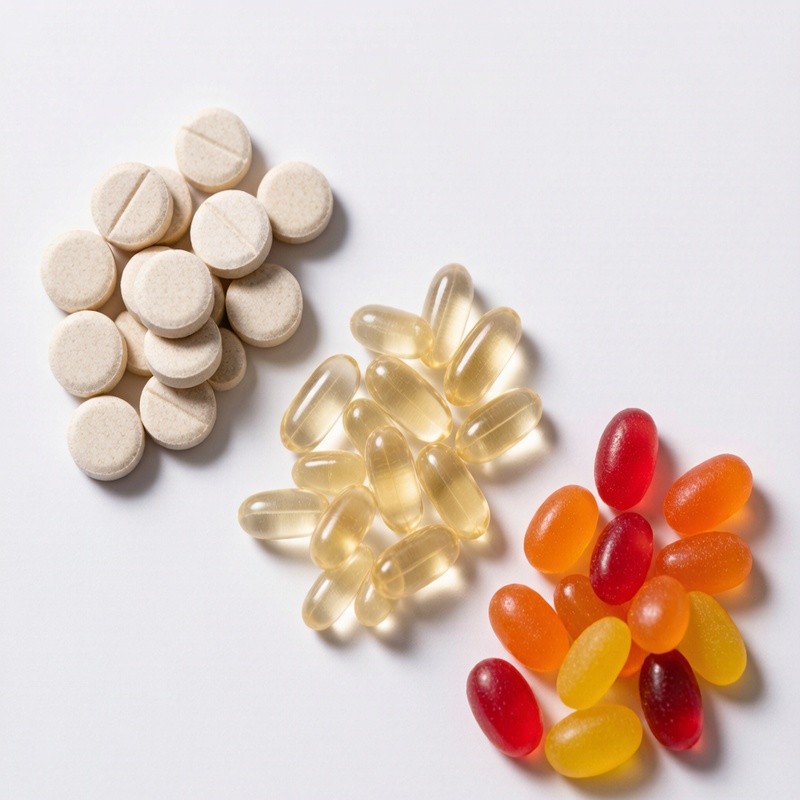
When developing a new dietary supplement, one of the most consequential decisions a brand faces is selecting the right dosage form. Tablets, capsules, and gummies each offer distinct advantages and trade-offs across cost, manufacturing complexity, consumer appeal, and ingredient compatibility. This article provides a detailed comparison to help brands navigate this critical choice and select the format that best aligns with their product goals, target audience, and budget.
Why Dosage Form Selection Matters
The dosage form is the physical vehicle that delivers active nutritional ingredients to the consumer. It influences virtually every aspect of a supplement product, from how the active ingredients are protected and released, to how the product is manufactured, packaged, priced, and perceived by consumers. A poorly chosen dosage form can lead to formulation challenges, manufacturing inefficiencies, poor consumer compliance, or even reduced efficacy. Conversely, the right choice can enhance product performance, streamline production, and create a compelling consumer experience that drives repeat purchases.
Three dosage forms dominate the dietary supplement market: tablets, capsules, and gummies. Each has evolved through decades of pharmaceutical and nutritional science, and each occupies a distinct position in the market. Understanding their differences is the first step toward making an informed product development decision.
Tablet Supplements: The Industry Workhorse
Tablets are solid dosage forms created by compressing a blend of active ingredients and excipients under high pressure. They are the most widely used format in the supplement industry, and for good reason. The compression process allows tablets to hold the highest concentration of active ingredients per unit of any common dosage form, making them ideal for nutrients that require larger doses such as calcium, magnesium, and vitamin C.
Tablets also offer the lowest per-unit production cost at scale, thanks to highly automated, high-speed manufacturing equipment that can produce hundreds of thousands of tablets per hour. The solid, compressed structure provides excellent stability, protecting sensitive ingredients from moisture, light, and oxygen. Coating technologies further enhance stability, enable taste masking, and allow for customized release profiles such as enteric or sustained release.
Best suited for: High-dose nutrients, cost-sensitive product lines, products requiring customized release profiles, and markets where consumers prioritize value and precision dosing.
Capsule Supplements: Flexibility and Consumer Preference
Capsules enclose powdered, liquid, or semi-solid ingredients within a dissolvable shell. The two primary types are hard capsules, typically made from gelatin or vegetable cellulose (HPMC), and softgel capsules, which seal a liquid fill inside a soft, flexible shell. Capsules are valued for their versatility in formulation, as they can accommodate ingredients that are difficult to compress into tablets, such as oils, liquid extracts, and hygroscopic powders.
From a consumer perspective, capsules are often perceived as easier to swallow than tablets, thanks to their smooth, gelatin-coated surface. They also eliminate taste issues, as the shell completely encloses the ingredients. However, capsules generally have lower ingredient loading capacity than tablets, higher per-unit manufacturing costs, and face heat and humidity sensitivity during storage, particularly for gelatin-based shells.

Gummy Supplements: The Taste-Driven Growth Segment
Gummy supplements have experienced explosive growth over the past decade, driven primarily by their appeal to consumers who dislike swallowing pills. Gummies are gelatin- or pectin-based confections that incorporate active ingredients into a chewable, fruit-flavored matrix. They are especially popular in the children's supplement market and have gained significant traction among adults for vitamins, minerals, and botanical extracts.
The primary advantage of gummies is consumer compliance. The pleasant taste and candy-like experience make daily supplementation feel less like a chore, which can improve adherence to supplement regimens. However, gummies come with notable limitations. They have the lowest active ingredient loading capacity of the three formats, are sensitive to heat and moisture, often require added sugars or sugar alcohols, and face stability challenges for certain nutrients. Manufacturing gummies also involves more complex processes and tighter environmental controls than tablet or capsule production.
Best suited for: Children's supplements, low-dose vitamins and minerals, products targeting consumers with pill aversion, and brand lines emphasizing a premium, enjoyable consumer experience.
Head-to-Head Comparison: Key Factors
To provide a clear overview, the following comparison highlights how tablets, capsules, and gummies stack up across the factors that matter most to supplement brands.
| Factor | Tablets | Capsules | Gummies |
|---|---|---|---|
| Ingredient loading capacity | |||
| Production cost at scale | |||
| Manufacturing speed | |||
| Stability and shelf life | |||
| Consumer swallowability | |||
| Taste and palatability | |||
| Release profile customization | |||
| Sugar content concerns | |||
| Suitability for oils/liquids |

How to Choose the Right Dosage Form for Your Brand
There is no single best dosage form for every product. The optimal choice depends on a combination of factors related to your active ingredients, target consumers, budget, and brand positioning. The following decision framework can help guide the selection process.
Consider Your Active Ingredients
The physical and chemical properties of your active ingredients are the most important starting point. High-dose nutrients like calcium, magnesium, and vitamin C are best suited for tablets, which can accommodate the necessary volume. Oils, liquid extracts, and fat-soluble vitamins like fish oil and vitamin E are ideal for softgel capsules. Low-dose vitamins and minerals that need broad consumer appeal may work well as gummies.
Understand Your Target Consumer
Consumer preferences vary significantly by demographic. Older adults may prefer easy-to-swallow capsules. Parents shopping for children often choose gummies for their palatability. Value-conscious consumers and those who take multiple supplements daily often favor tablets for their cost efficiency and compact size. Understanding your target audience's preferences and pain points is essential.
Evaluate Budget and Production Scale
Budget constraints and expected production volumes play a major role. If you are launching at high volume and need to keep per-unit costs low, tablets are typically the most economical choice. For smaller production runs or products where the premium capsule format adds perceived value, capsules may be worth the additional cost. Gummies require significant investment in specialized equipment and environmental controls, making them most viable at sufficient scale.
Assess Stability Requirements
If your active ingredients are sensitive to moisture, heat, or oxidation, the dosage form's protective properties become critical. Tablets offer the best inherent stability, followed by hard capsules. Gummies are the most vulnerable to environmental factors and may require special packaging and storage conditions.
Pro tip: Many successful supplement brands offer the same core formula in multiple dosage forms to serve different consumer segments. For example, a multivitamin might be available as both a tablet and a gummy, each targeting a different audience. Learn more about our manufacturing capabilities across all dosage forms.
Frequently Asked Questions
Which dosage form is the cheapest to manufacture?
Tablets are generally the cheapest to manufacture at scale, due to highly automated compression equipment and lower excipient costs. Capsules are moderately more expensive, and gummies are typically the most costly due to complex processing and environmental control requirements.
Are gummies less effective than tablets?
Gummies are not inherently less effective, but their lower ingredient loading capacity means they may contain lower doses of certain nutrients per serving. For high-dose nutrients, tablets or capsules may be more appropriate. The effectiveness of any supplement depends on the formulation quality and bioavailability, not the dosage form alone.
Can I switch my product from one dosage form to another?
Yes, but it requires reformulation. Each dosage form has different requirements for excipients, processing, and stability. Switching from a tablet to a gummy, for example, involves significant formulation development work. Working with an experienced contract manufacturer can streamline this transition.
Which dosage form has the longest shelf life?
Tablets typically have the longest shelf life, often 24 to 36 months, due to their solid compressed structure that protects ingredients from environmental factors. Hard capsules generally offer 24 to 36 months as well, while gummies often have shorter shelf lives of 18 to 24 months due to moisture sensitivity.
Conclusion
Choosing between tablets, capsules, and gummies is a decision that shapes every aspect of a supplement product, from formulation and manufacturing to consumer experience and pricing. Tablets excel in cost efficiency, ingredient loading, and stability. Capsules offer formulation flexibility and consumer-friendly swallowing. Gummies win on taste and compliance, particularly for pill-averse demographics. The right choice depends on your specific active ingredients, target market, budget, and brand strategy. By carefully weighing these factors, you can select a dosage form that maximizes both product performance and commercial success. For personalized guidance on selecting the optimal dosage form for your supplement line, reach out to our formulation team.