Wholesale Nutraceuticals Equipment: What Brands Need to Scale
- Share
- publisher
- FORNUTRA Editorial Team
- Issue Time
- Nov 25,2026
Summary
Should your brand buy supplement manufacturing machines or keep outsourcing? This guide compares tablet press, encapsulation machine, gummy depositor and blister packaging line costs against contract manufacturing - with GMP validation, cleanroom and QA overhead included in the math.
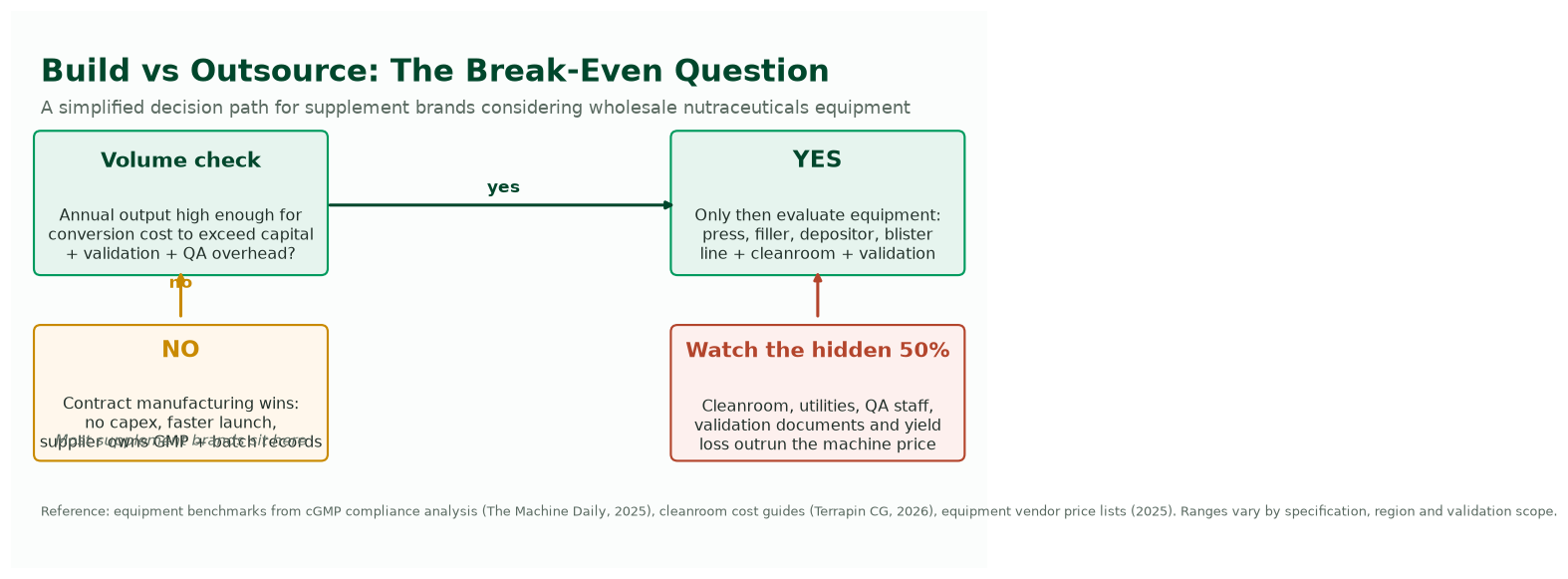
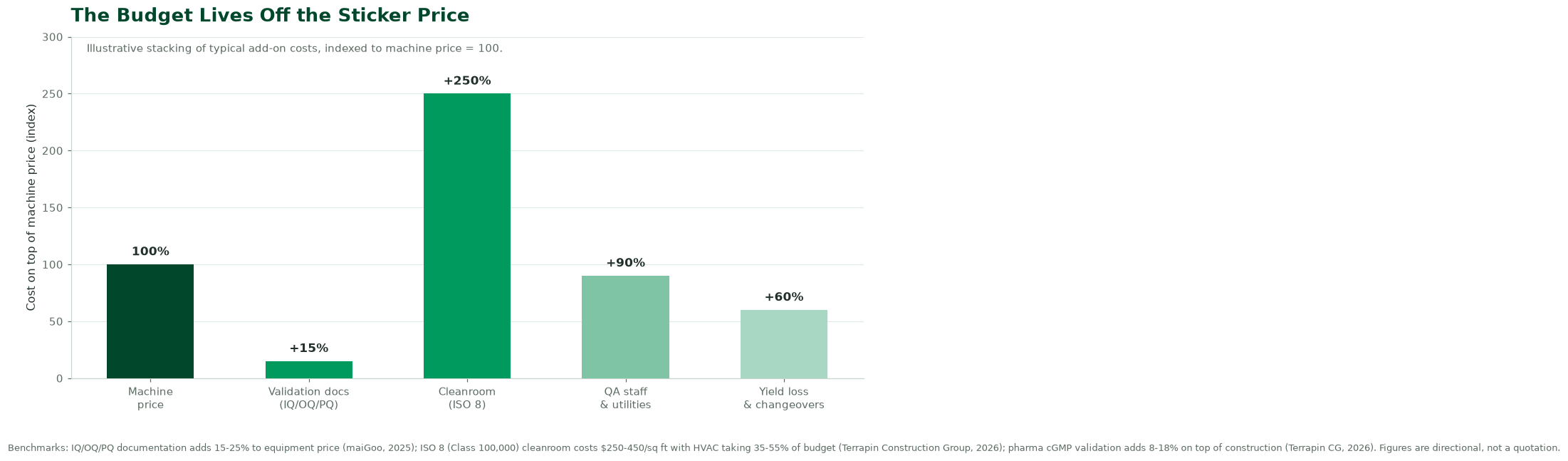
Buying wholesale nutraceuticals equipment only makes sense above a volume threshold where your annual conversion cost exceeds capital, validation and QA overhead — below it, contract manufacturing is cheaper and faster. Most brands never cross that line: the machines themselves are the smallest line item next to cleanrooms, validation documents and quality staff. At some point in every growing supplement brand, the same question lands in an operations review: should we buy the machines? It usually arrives after the third price increase from a supplier, or when a bestseller stockout proves the batch schedule has stopped fitting the sales curve. The question sounds like a capacity decision, but it is really a cost decision — and the honest answer depends on numbers most first-time buyers never see. Before comparing any wholesale nutraceuticals equipment quote, it helps to understand how the wholesale supply chain works and where a factory actually earns its margin. That context matters, because the equipment question almost always comes from brands that are profitable — and the fastest way to stop being profitable is to buy production assets your volume cannot carry. Outsourcing is not a compromise; it is the industry's default. The global dietary supplement OEM/ODM market was valued at USD 21.5 billion in 2025 and is projected to reach USD 36.49 billion by 2032, growing at a 7.85% CAGR (PW Consulting, 2026). Within it, OEM private-label production accounts for roughly 60% of revenue, and tablets plus capsules represent about 55% of dosage-form demand. Most brands that sell supplements today buy finished stock the way our guide to buying vitamins wholesale describes — and have never owned a mixer, let alone a press. The economics explain why. Pheonix Research (2026) modeled the branded supplement market at USD 189.4 billion in 2025 against a contract manufacturing layer of about USD 31.8 billion — the factory captures roughly 7.7 cents of every dose, versus about 46 cents of retail value. Manufacturing is where cost lives; brand value is built elsewhere. Buying equipment does not change that arithmetic, it only moves the fixed cost onto your balance sheet. The break-even question is blunt and simple: does your annual conversion cost exceed the capital, validation and QA overhead of running your own line? If not, a modern supplement manufacturing base will produce your products at a per-unit cost you cannot match with your own room. The flow below shows the decision path most brands should walk before opening any equipment catalogue. One correction to a common belief: equipment is not the biggest cost of an in-house line. According to 2026 cleanroom construction cost data from Terrapin Construction Group, an ISO 8 (Class 100,000) cleanroom — the grade most supplement formats need — runs USD 250–450 per square foot, with HVAC and filtration taking 35–55% of the budget, and pharma-grade cGMP validation adding another 8–18% on top. A 3,000 sq ft room can therefore cost more than the tablet press inside it. There is no such thing as a general-purpose supplement machine. Each dosage form requires a separate, incompatible line: a press cannot make gummies, a depositor cannot fill capsules, and a blister packaging line only pays for itself if you already sell in blisters. Brands that ask for an equipment list usually discover they need four to six machines plus utilities before the first commercial batch. For a compliant cGMP start, a tablet press is the classic entry point — and the classic trap. A compliance analysis of 21 CFR Part 111 equipment (The Machine Daily, 2025) puts enclosed rotary presses at USD 14,000–25,000 for small-scale cGMP models, while the widely advertised USD 800–1,200 single-punch TDP-style machines fail audit because their open-cam design sheds grease into the product zone. At industrial scale, high-speed rotary presses from domestic vendors run from roughly USD 70,000 to USD 300,000+ depending on stations, tooling and data-recording options. An encapsulation machine follows the same tiering: semi-automatic desktop fillers are acceptable for R&D only, while enclosed automatic models with weight-check rejection (NJP-series class) typically cost USD 28,000–45,000. The 21 CFR 111.230 master manufacturing record requirement makes automated weight sorting non-negotiable for commercial batches. If tablets are your format, this is the point to compare against what a dedicated tablet supplement manufacturer already owns — the same press, plus the cleanroom, plus the batch records. A gummy depositor is the most deceptive machine in the category. 2025 vendor price lists (gummymaking.com) show semi-automatic units from USD 6,000–20,000, automatic machines at USD 30,000–50,000, and complete turnkey lines — cooking kettles, depositing, cooling tunnel and packaging — at USD 50,000–150,000 for 1,000–5,000 kg/day. Fully automatic starch-free plants with robotics run USD 1.8–4 million or more. The starch question alone changes the plant design: starchless lines cost far more upfront but remove a whole waste and contamination stream. Liquid filling adds its own line: filling, capping and labeling equipment sized to bottle format, with clean-in-place requirements most newcomers underestimate. And a blister packaging line — PVC/PVDC or Alu-Alu — starts around USD 18,000–35,000 for semi-automatic models and reaches USD 65,000–150,000 for mid-speed GMP lines (HIJ Machinery, 2025); Alu-Alu cold-forming alone typically costs 40–60% more than thermoforming. The table below consolidates the reference bands used throughout this article. Reference bands compiled from The Machine Daily cGMP analysis (2025), gummymaking.com and HIJ Machinery price lists (2025), and CNY vendor listings (maiGoo, 2025). These are directional ranges, not quotations — final prices move with speed, materials and validation documentation. The moment a brand buys a machine, it also buys a documentation obligation. IQ (installation), OQ (operational) and PQ (performance) qualification for a single pharmaceutical blister machine typically takes 4–8 weeks from installation to sign-off (HIJ Machinery, 2025), and full IQ/OQ/PQ protocol packages add roughly 15–25% to equipment price (maiGoo, 2025). Under 21 CFR Part 111, every product-contact surface must be 316L stainless with a surface finish below Ra 0.8 µm; calibration schedules, master batch records and complaint files all fall on the brand. Certification on top of GMP — the seals your retail buyers actually ask for — is a separate layer, which is why it is worth understanding what third-party certification marks really verify before promising them to a customer. Then come the operating costs. QA staff, utilities, calibration contracts, retain samples and the yield loss every startup line suffers while operators climb the learning curve. In the US market, Terrapin's 2026 data puts an ISO 8 cleanroom at USD 250–450/sq ft; in China, established cleanroom contractors quote roughly RMB 5,000–8,000 per square meter for the equivalent Class 100,000 grade. Either way, the room often outcosts the machine — and the room must be validated too. To make the decision concrete, build a three-year model rather than comparing today's invoice to today's quote. The chart below is an illustrative comparison for a single dosage form, not a market standard — every brand's inputs differ, so use the structure and replace the totals. Illustrative model, not a quotation. Equipment prices, cleanroom costs and per-unit conversion rates vary widely by market and format; run the model with your own supplier quotes before deciding. The pattern holds across most brands we speak with: below roughly 1–2 million units per year per format, fixed overhead eats the margin an owned line is supposed to create; above it, in-house production starts to look rational — for that one format. A brand running tablets, gummies and powders would need three lines, three validation programs and three times the QA headcount. This is the part of the conversation where FORNUTRA usually enters. Instead of owning the fixed costs above, brands can buy the finished capability: three manufacturing bases — a 20,000 m² integrated supplement R&D and manufacturing center in Guangzhou plus two 10,000 m² production centers in Zhengzhou — running 20 fully automated production lines with German and Italian equipment inside an 8,000 m² Class 100,000 GMP cleanroom. Daily capacity spans 3M+ tablets, 2M capsules, 8M gummies, 800K powder sachets and more, under cGMP, HACCP, ISO 22000, FDA, NSF and HALAL certification. Full details on the supplement manufacturing bases page. Published on FORNUTRA's official site. Final MOQ and lead time depend on formula, size, coating and packaging, and are confirmed in the quotation. In every format, the comparison is the same: your projected annual volume against a fixed-cost line, or the same volume against a per-unit contract quote. The brand keeps the margin math, and the tablet supplement manufacturer side keeps the machines. Equipment or outsourcing is never decided by a catalogue — it is decided by your volume model against a real quote. If your brand is weighing build-versus-buy, Contact our supply team with your projected annual volume per format. We will run the numbers with you and send the matching MOQ, lead time and quotation — whether or not you end up working with us, the comparison will tell you which side of the break-even line your brand sits on. A compliant small-scale cGMP line starts with an enclosed rotary press at roughly USD 14,000–25,000; high-speed industrial presses run USD 70,000–300,000+. The machine is rarely the deciding number — the cleanroom, IQ/OQ/PQ validation and tooling usually cost more than the press itself. Treat published figures as reference ranges and confirm everything in a formal quote. Yes — contract manufacturing is exactly that: rented capacity plus a rented quality system. You pay per unit instead of owning depreciation, validation and QA headcount, and you can scale formats without buying a second line. FORNUTRA's OEM service works this way, with format-level MOQs such as 200 kg of powder per SKU as a starting reference.Wholesale Nutraceuticals Equipment vs Outsourced Manufacturing
Equipment List for Tablets, Capsules, Gummies and Liquids
Tablet Press and Encapsulation Machine Selection
Gummy Depositor and Liquid Filling Lines
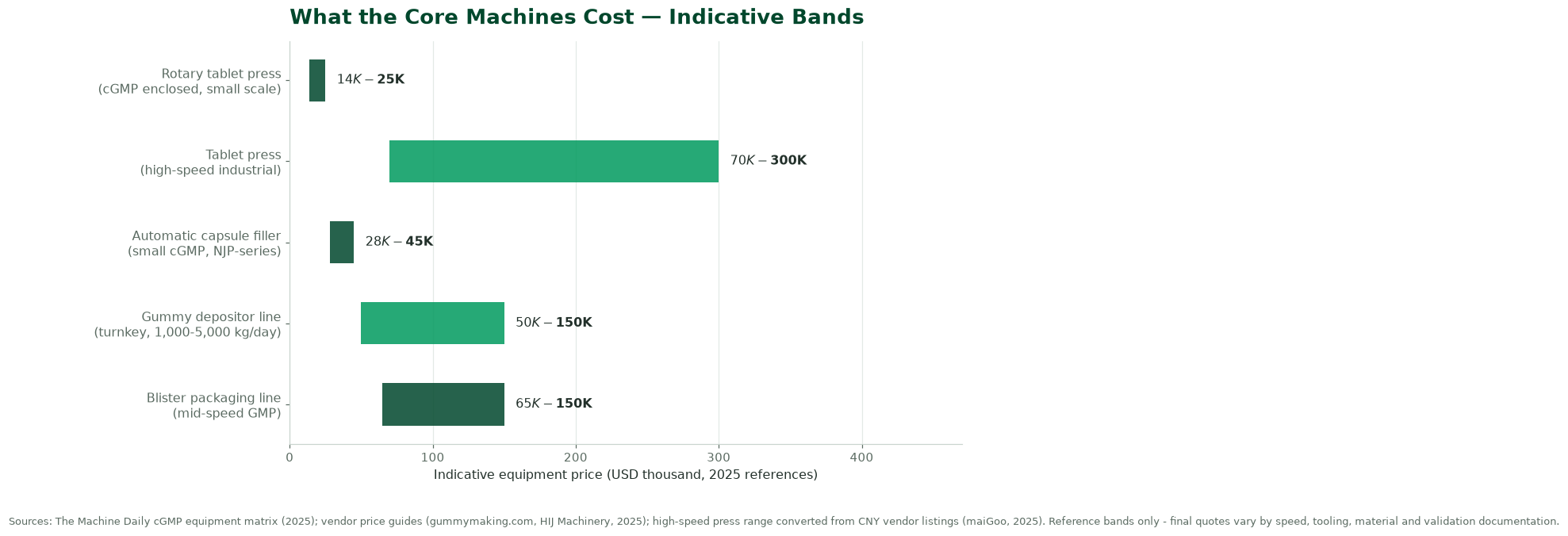
Machine Entry / small cGMP Mid / industrial What the price excludes Rotary tablet press USD 14K–25K USD 70K–300K+ Tooling sets, dust extraction, IQ/OQ/PQ documents Automatic capsule filler USD 28K–45K USD 100K+ Weight-check rejection, change parts Gummy depositor line USD 6K–20K (semi-auto) USD 50K–150K (turnkey) Starchless upgrade, cooling tunnel, packaging Blister packaging line USD 18K–35K USD 65K–150K (GMP) Alu-Alu forming (+40–60%), vision, cartoner Validation, Calibration and GMP Documentation
Cost Model: Equipment vs Per-Unit Manufacturing
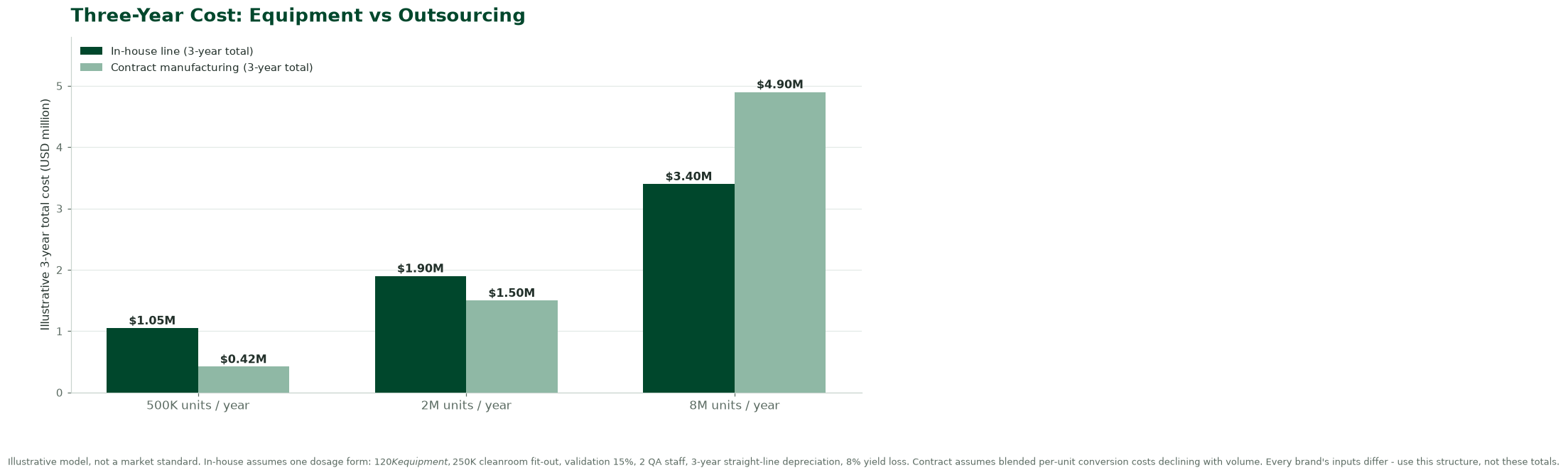
Annual volume In-house line (3-yr total) Contract manufacturing (3-yr total) Cheaper route 500K units / year ≈ USD 1.05M ≈ USD 0.42M Contract 2M units / year ≈ USD 1.90M ≈ USD 1.50M Contract (narrow gap) 8M units / year ≈ USD 3.40M ≈ USD 4.90M In-house Outsource Instead with FORNUTRA
Product format Reference MOQ Sample lead time Production lead time Tablets / effervescent 1,000 bottles 3–5 days 7–10 days Capsules 500 bottles 3–5 days 7–15 days Gummies 500 bottles 2–4 days 10–20 days Powder 200 kg 3–5 days 7–10 days Drops 500 bottles 3–5 days 7–10 days FAQ