How GLP-1 Is Influencing Supplement Innovation in 2026: Protein, Fiber and Functional Nutrition Trends
- Share
- publisher
- FORNUTRA
- Issue Time
- Sep 9,2026
Summary
Explore how GLP-1 trends are influencing supplement innovation in 2026, driving demand for protein, fiber, hydration, gut health, and multifunctional nutrition products.
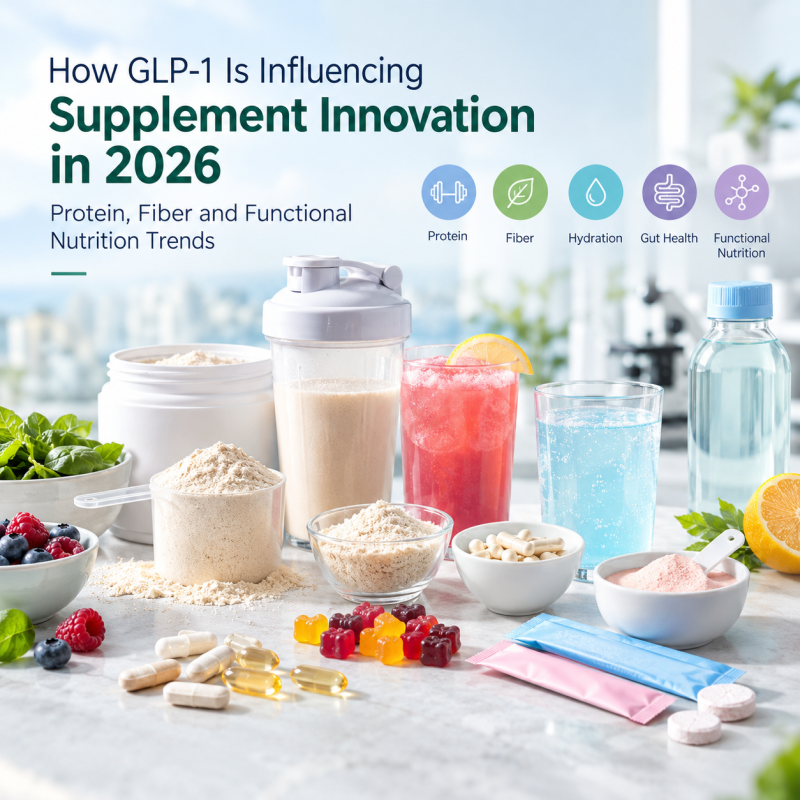
The growing influence of GLP-1 medications is creating changes far beyond the pharmaceutical market. Across the food, beverage, and supplement industries, brands are paying closer attention to how consumers think about nutrition, convenience, and product functionality.
Rather than creating an entirely separate category, the GLP-1 trend is accelerating several developments that were already gaining momentum in the supplement industry. Protein, fiber, hydration, gut health, nutrient density, and convenient delivery formats are becoming increasingly important areas of product innovation.
For supplement brands, the opportunity is not simply to create products associated with GLP-1. It is to understand the broader consumer trends behind this shift and translate them into practical, well-formulated products.
GLP-1 Is Changing Consumer Nutrition Priorities
As GLP-1 use expands, nutrition companies are observing changes in consumer purchasing behavior. Industry research points to growing interest in protein, fiber, probiotics, nutrient-rich foods, and simpler ingredient profiles. These preferences are also spreading beyond consumers directly using GLP-1 products, contributing to broader changes in mainstream nutrition.
This creates an important distinction for supplement brands. The market opportunity is not limited to products specifically positioned around GLP-1. Instead, brands can respond to wider consumer interest in nutrient density, balanced nutrition, functional ingredients, and convenient daily supplementation.
As a result, product development is increasingly moving from single-ingredient positioning toward formulas that combine multiple nutritional priorities in one product.
Protein Moves Further Into Everyday Nutrition
Protein has become one of the most visible trends in the nutrition market. Once strongly associated with sports nutrition and bodybuilding, protein is increasingly being incorporated into everyday foods, beverages, and supplements.
Recent industry analysis shows that GLP-1-related changes are accelerating demand for nutrient-dense, protein-focused formats, while protein itself is becoming a broader consumer expectation. At the same time, formulation remains challenging because protein can affect taste, texture, viscosity, shelf stability, and processing.
This is creating opportunities for a wider range of protein products, including:
Whey and plant-based protein powders
Single-serving protein sachets
Protein and collagen combinations
Protein and creatine formulas
Protein and fiber products
Ready-to-mix functional nutrition powders
For brands, the competitive advantage is increasingly moving beyond simply adding more protein. Taste, texture, ingredient compatibility, dosage format, and overall consumer experience are becoming equally important parts of product development.
Fiber and Gut Health Continue to Expand
Fiber is another category receiving increasing attention. Industry reports indicate that fiber is becoming an important part of 2026 product innovation, while new product development is extending fiber into gummies, functional beverages, sports nutrition, and other convenient formats.
The opportunity also goes beyond traditional fiber supplements. Brands are experimenting with combinations involving prebiotics, probiotics, and other functional ingredients to create more comprehensive gut-health products.
For supplement manufacturers, this trend creates new formulation considerations. Different fiber ingredients can influence solubility, viscosity, texture, flavor, and dosage size. Combining fiber with probiotics, proteins, minerals, or other active ingredients can add further technical complexity.
This makes formulation expertise increasingly important when brands move from a market concept to a commercially viable product.
Hydration Is Becoming a More Functional Category
Hydration is also evolving from a simple beverage category into a broader functional nutrition opportunity.
Electrolyte powders, stick packs, effervescent formats, and functional hydration beverages are gaining attention as consumers look for convenient ways to incorporate hydration into their daily routines.
Industry reports have identified hydration as one of the key opportunities emerging alongside protein and fiber, with functional ingredients increasingly being incorporated into drink formats.
This trend creates room for formulas combining electrolytes with minerals, vitamins, amino acids, or other functional ingredients.
For brands, portability is another important factor. Single-serving sachets and stick packs can make products easier to use at work, while traveling, or before and after physical activity. Flavor development, solubility, stability, and ingredient compatibility therefore become critical considerations during formulation.
Multifunctional Formulas Are Becoming More Attractive
One of the clearest developments across the supplement industry is the movement toward multifunctional products.
Consumers increasingly expect one product to fit naturally into their daily routine rather than taking multiple single-purpose products. At the same time, brands are looking for ways to differentiate products in increasingly competitive categories.
This has encouraged combinations such as:
Protein + Collagen
Protein + Creatine
Protein + Fiber
Electrolytes + Minerals
Fiber + Probiotics
Protein + Vitamins and Minerals
The growth of these combinations reflects a broader shift in product development. Instead of focusing only on an individual ingredient, brands are considering how multiple ingredients can work together within one convenient format.
However, multifunctional formulations also require careful development. Ingredient compatibility, dosage, taste, texture, stability, and manufacturing processes all need to be evaluated before commercial production.
What These Trends Mean for Supplement Brands
The changing nutrition landscape is giving supplement brands new opportunities, but it is also raising the standard for product development.
A successful product increasingly requires more than a trending ingredient. Brands need to consider the complete product experience, including:
Target consumer and market positioning
Formula composition and ingredient compatibility
Appropriate dosage form
Taste, texture, and solubility
Stability and shelf life
Quality testing and production consistency
Scalable manufacturing
This is particularly important as brands move toward functional powders, gummies, capsules, tablets, softgels, liquids, and convenient single-serving formats.
The GLP-1 trend is therefore better understood as a category accelerator rather than a standalone supplement category. It is bringing greater attention to nutrition priorities that were already developing across the wider wellness market. Recent industry analysis similarly suggests that the long-term opportunity may extend beyond products explicitly labeled for GLP-1 consumers, with protein, fiber, probiotics, hydration, and targeted nutrition remaining relevant across mainstream wellness categories.
From Market Trends to Supplement Product Development
As these trends continue to develop, supplement brands need more than access to individual ingredients. Successful product development increasingly requires the ability to combine ingredients, select appropriate dosage forms, develop appealing flavors, conduct quality testing, and scale formulas for commercial production.
For companies responding to these emerging opportunities, an experienced OEM/ODM partner such as FORNUTRA can support the transition from market insight to finished supplement product, combining formulation development with flexible manufacturing across multiple dosage forms.
Looking Ahead: A Broader Shift in Supplement Innovation
The influence of GLP-1 is likely to extend beyond products specifically associated with weight management. More importantly, it is accelerating a broader shift toward nutrient-dense, multifunctional, convenient, and consumer-focused nutrition products.
For supplement brands, the opportunity is not simply to follow the latest GLP-1 terminology. It is to understand the underlying changes in consumer priorities and develop products that remain relevant as those priorities evolve.
Protein, fiber, hydration, gut health, and multifunctional nutrition are already becoming important areas of supplement innovation. As these trends continue to converge, brands and manufacturers that can combine strong formulation capabilities with flexible dosage formats and scalable production will be better positioned to turn emerging market opportunities into practical products.