FDA Highlights Key Considerations for Gummy Supplement Manufacturing and Testing in 2026
- Share
- publisher
- FORNUTRA
- Issue Time
- Sep 21,2026
Summary
FDA researchers highlight key considerations in gummy supplement formulation, manufacturing, stability, and testing, offering practical insights for brands evaluating gummy OEM manufacturing partners.
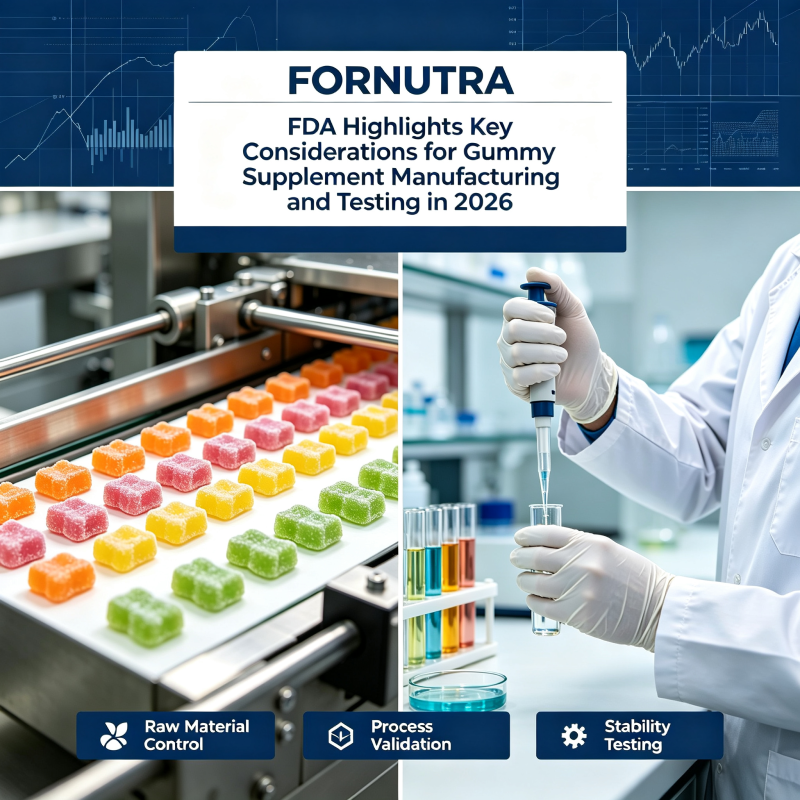
Gummy supplements have become an increasingly popular format for dietary supplement brands, offering a convenient alternative to traditional capsules and tablets. As demand continues to grow, manufacturers and brands are paying closer attention to formulation, manufacturing processes, stability, and finished-product testing.
In September 2026, researchers from the U.S. Food and Drug Administration (FDA) highlighted several technical considerations related to gummy dietary supplements. While the publication does not introduce new gummy-specific regulations, it provides useful insight into the scientific and manufacturing factors that can affect gummy supplement quality.
Gummy Formulation Requires a Specialized Approach
Unlike conventional tablets or capsules, gummies rely on a matrix that combines active ingredients with components responsible for texture, structure, flavor, and stability.
The FDA perspective highlights that gummy formulations can vary significantly depending on the active ingredients and the materials used to create the gummy matrix. Ingredients such as gelatin, pectin, and other hydrocolloids can influence the final product's physical properties and may also affect how active ingredients behave within the formulation.
For supplement brands, this means that developing a gummy product is not simply a matter of converting an existing capsule or powder formula into a gummy format. Ingredient compatibility, dosage, texture, processing conditions, and finished-product characteristics all need to be considered during development.
Stability Is an Important Consideration
Stability is another important factor in gummy supplement manufacturing.
Gummies contain a structured matrix and may have different moisture characteristics from other dosage forms. Factors such as water activity, pH, hydrocolloid selection, and storage conditions can influence product stability over time.
The FDA's Human Foods Program has identified areas such as water activity, pH, hydrocolloid types, and the stability of micronutrients and bioactive compounds in gummy matrices as relevant research considerations.
For brands developing gummy supplements, stability should therefore be considered during formulation and manufacturing rather than only after the product has been completed.
Testing and Quality Control Matter
Gummy supplements can also present specific challenges for analytical testing because the gummy matrix may interact with or affect the measurement of certain active ingredients.
Appropriate analytical methods, reference standards, and validated testing procedures are important for confirming product identity, ingredient levels, and consistency.
From a manufacturing perspective, quality control also needs to cover more than the active ingredients alone. Factors such as weight variation, texture, appearance, moisture, and batch-to-batch consistency can all be relevant to the finished product.
A well-defined testing and quality-control process helps manufacturers identify potential variations and maintain consistent product specifications across production batches.
What Should Brands Consider When Choosing a Gummy OEM Manufacturer?
For brands evaluating gummy supplement manufacturers, several practical questions can help determine whether a supplier is suitable for a project:
-
- 1. Can the manufacturer support formula development?
The supplier should be able to evaluate ingredient compatibility and formulation requirements for the intended gummy format.
-
2. How are stability considerations addressed?
Stability-related factors should be considered during formulation and production planning. -
-
3. What testing is performed on finished gummies?
Brands should understand which quality and analytical tests are included in the manufacturing process. -
-
4. How is batch consistency controlled?
Consistent dosage, appearance, texture, and other specifications are important for commercial production. -
-
- 5. Can the manufacturer support different gummy formulations?
Different active ingredients and formulation objectives may require different development approaches.
- 5. Can the manufacturer support different gummy formulations?
For an OEM/ODM manufacturer such as FORNUTRA, these considerations connect formulation requirements with practical manufacturing and quality-control processes. This integrated approach can be relevant for brands developing gummy products for international markets.
What This Means for Supplement Brands
The FDA's recent publication does not suggest that gummy supplements are unsuitable for commercial development. Instead, it highlights the technical considerations involved in manufacturing and testing this dosage form.
For brands, the key takeaway is that gummy product development should be viewed as a complete process rather than a single formulation step:
Formula Compatibility → Manufacturing → Stability → Testing → Finished-Product Specifications
Considering these factors early can help brands communicate clearer requirements to potential manufacturing partners and reduce formulation or production issues later in the development process.
Looking Ahead
The growing demand for gummy supplements is likely to keep formulation and quality considerations in focus as more brands enter the category.
The FDA's latest perspective provides additional insight into the relationship between gummy formulation, manufacturing, stability, and analytical testing. At the same time, the FDA's research priorities indicate continued scientific interest in understanding how gummy matrices affect ingredient stability and testing.
For international supplement brands looking for a manufacturing partner across different dosage forms, FORNUTRA provides OEM and ODM manufacturing solutions covering gummies and other supplement formats, supporting projects from formulation requirements through commercial manufacturing.
Sources
-
1. U.S. Food and Drug Administration (FDA) — HFP Priority Research, Data, and Method Needs
-
2. Journal of Dietary Supplements — Perspective on Gummy Dietary Supplements Manufacturing and Testing
- 3. SupplySide Supplement Journal —Supplement Shorts: What the FDA Really Thinks About Gummy Supplements