FDA Supplement Listing Gains Consumer Support: What Global Supplement Brands Need to Know in 2026
- Share
- publisher
- FORNUTRA
- Issue Time
- Oct 8,2026
Summary
A new CRN survey finds 76% of U.S. adults support FDA supplement listing, highlighting the growing importance of transparency for global supplement brands.
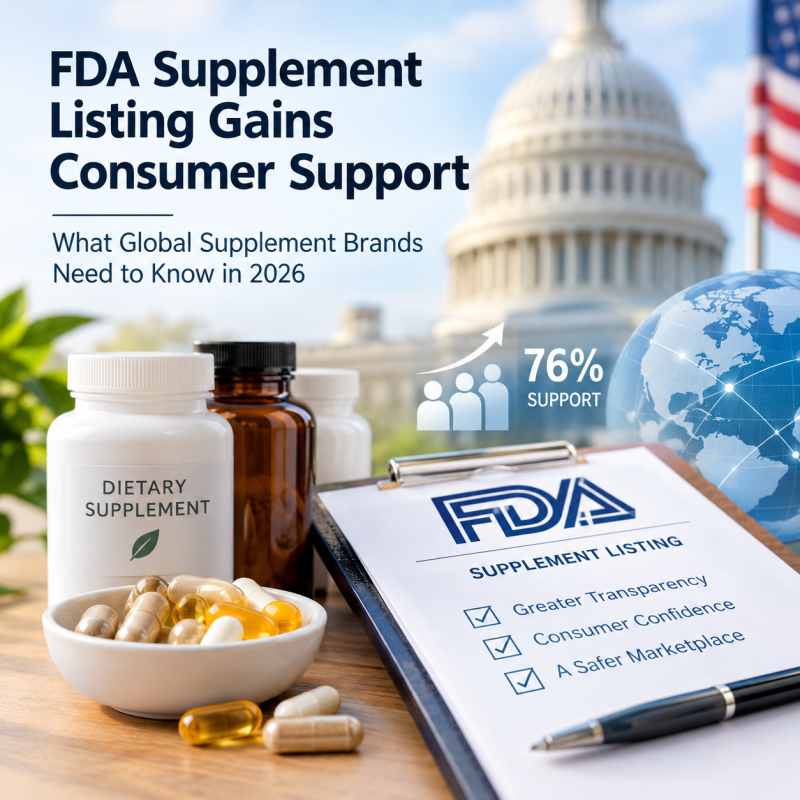
A new U.S. consumer survey is putting dietary supplement transparency back in the spotlight. According to findings released by the Council for Responsible Nutrition (CRN) on October 7, 76% of U.S. adults say requiring marketed dietary supplements to be listed with the U.S. Food and Drug Administration (FDA) would increase their confidence in supplements at least somewhat. [1]
The finding comes as the U.S. continues to consider a federal dietary supplement listing framework. For global supplement brands selling or planning to enter the U.S. market, the discussion could have implications for product information, development processes, and how brands work with manufacturing partners.
Consumer Confidence Is Driving New Attention to Supplement Listing
The 2026 CRN national consumer survey, conducted by Morning Consult among 3,005 U.S. adults, provides a new consumer perspective on the discussion around dietary supplement listing.
CRN found that 76% of respondents believe FDA listing would increase their confidence in dietary supplements. The survey also indicates that consumers place importance on transparency and measures that can help distinguish legitimate products from illegal, contaminated, or misleading products.
The findings are significant because consumer confidence is increasingly connected with how clearly products can be identified and how reliably consumers can access information about the products they purchase.
For supplement brands, this suggests that transparency may become an increasingly important part of the overall product value proposition—not simply a regulatory consideration.
What Is the Dietary Supplement Listing Proposal?
The discussion centers partly on the Dietary Supplement Listing Act of 2026, introduced in the U.S. Senate as S. 3677.
The proposed legislation would amend the Federal Food, Drug, and Cosmetic Act to require manufacturers of dietary supplements to list dietary supplements with the FDA. It also proposes making specified product information available through a searchable database. [2]
Importantly, the legislation is proposed rather than an active blanket FDA listing requirement. Its provisions could change as the legislative process develops.
Nevertheless, the proposal signals continued interest in increasing visibility into the U.S. dietary supplement marketplace. CRN has also identified dietary supplement listing as a policy priority focused on greater transparency for regulators, retailers, and consumers.
What Could This Mean for Global Supplement Brands?
If a federal listing framework is eventually adopted, its impact could extend beyond regulatory teams.
For international brands developing products for the U.S. market, accurate and consistent product information could become increasingly important across the commercial development process.
This may include:
-
· Product identity and formulation information
-
· Responsible-party information
-
· Label and packaging details
-
· Product specifications
-
· Manufacturing documentation
-
· Consistency between the developed product and the product placed on the market
For procurement and product-development teams, the key consideration is not simply whether a product can be manufactured. It is whether product requirements can remain clearly defined and consistently managed from initial formulation through commercial production.
Why Manufacturing Partners May Matter More
A potential product-listing framework could also influence how global brands evaluate OEM and ODM supplement manufacturers.
For a brand developing a private label or custom supplement, product development typically involves multiple stages, from formulation and specification development to manufacturing, packaging, and market launch.
When information changes during development, inconsistencies can emerge between formulation documents, packaging information, product specifications, and the final commercial product.
A manufacturing partner with an organized development process can help brands maintain alignment across these stages.
For B2B buyers, this makes several capabilities increasingly relevant when assessing potential suppliers:
Consistent Product Development
Formula requirements, dosage forms, ingredient specifications, and product objectives need to remain aligned throughout development.
Clear Communication
OEM and ODM projects often involve collaboration between brand owners, product developers, procurement teams, and manufacturers. Clear communication can help reduce discrepancies as a project moves toward production.
Documentation Readiness
As regulatory expectations evolve, organized product information and documentation can make it easier for brands to respond to changing market requirements.
U.S. Market Awareness
Brands targeting the U.S. should monitor regulatory developments early in the product-development process rather than treating market requirements as a final-stage consideration.
Transparency Could Become a Stronger Competitive Factor
The latest survey does not establish a new FDA requirement. Instead, it highlights growing consumer support for greater visibility in the dietary supplement marketplace.
This distinction matters for global brands.
A proposed listing framework may evolve before becoming law, and its eventual requirements could differ from the current proposal. However, the underlying direction—greater transparency around products marketed to consumers—is an important development for companies operating in the U.S. supplement market.
For manufacturers and brand owners, this creates an opportunity to consider transparency earlier in product development.
Rather than treating regulatory information as separate from product development, brands can incorporate accurate product specifications, consistent documentation, and clear communication with manufacturing partners into the overall commercialization process.
What Supplement Brands Should Watch Next
The next stage of the discussion will depend on how the Dietary Supplement Listing Act and related policy proposals develop.
Global supplement brands should monitor several areas:
-
-
· Whether a federal supplement listing framework advances through Congress
-
· What product information could ultimately be required
-
· How any future requirements could affect imported supplements
-
· Whether additional responsibilities could fall on manufacturers or responsible parties
-
· How listing requirements could interact with existing U.S. supplement regulations
For brands preparing new products for the U.S. market, the practical response is not to assume that a new requirement is already in effect. Instead, it is to stay informed and work with manufacturing partners that can support structured product development as regulatory expectations evolve.
FAQ: FDA Supplement Listing for Global Supplement Brands
Is FDA supplement listing currently mandatory?
No. The Dietary Supplement Listing Act of 2026 is proposed legislation. It has not established a blanket federal requirement for all dietary supplements to be listed with the FDA.
Why is FDA supplement listing receiving attention?
A new CRN survey found that 76% of U.S. adults believe FDA listing of marketed dietary supplements would increase their confidence in supplements. The finding adds a consumer perspective to the ongoing policy discussion around greater supplement marketplace transparency.
What could supplement listing mean for international brands?
If adopted, a federal listing system could increase the importance of accurate product information, consistent specifications, documentation, and coordination between brands and their manufacturing partners when preparing products for the U.S. market.
What should buyers consider when selecting an OEM or ODM supplement manufacturer?
B2B buyers should consider whether a manufacturing partner can maintain clear product specifications, coordinate formulation and production requirements, support organized documentation, and communicate effectively throughout the development and manufacturing process.
References
[1] Council for Responsible Nutrition (CRN). New CRN Survey Finds 76% of Americans Say FDA Supplement Listing Would Increase Consumer Confidence. October 7, 2026. Original Source
[2] U.S. Congress. Dietary Supplement Listing Act of 2026, S. 3677, 119th Congress. Original Source